A silicone mould is an investment intended to pay back through casting numbers. One of the first questions is how many pieces it can produce. The answer depends on factors you can partly control, from silicone choice to storage. We make moulds for concrete, plaster, resins and GRP, so we have collected everyday workshop observations.
What determines silicone mould life?
- Silicone type – addition-cure platinum silicones have low shrinkage and usually remain flexible longer; condensation-cure types cost less but stiffen and lose detail sooner. Hardness matters too: soft silicone releases undercuts more easily; harder silicone tolerates abrasion better.
- Casting material – concrete is abrasive and alkaline, plaster releases moisture and heat, while resins heat during curing and gradually ‘dry out’ the silicone.
- Element shape – thin edges, deep undercuts and fine ornament work hardest during demoulding and tear first.
- Mould construction – adequate silicone thickness and a rigid support shell prevent distortion during pouring and stretching during release.
- Working method – premature or forceful demoulding, sharp tools and aggressive cleaners shorten every mould’s life.
How many casts will a mould last?
There is no honest single number for every mould. With concrete and proper use, a well-made mould usually gives dozens to hundreds of casts. Plaster may be similar, while polyester and epoxy resins give fewer because reaction heat and resin components wear silicone faster. We ask about casting material and planned quantity before manufacture, as these determine silicone, wall thickness and support shell.
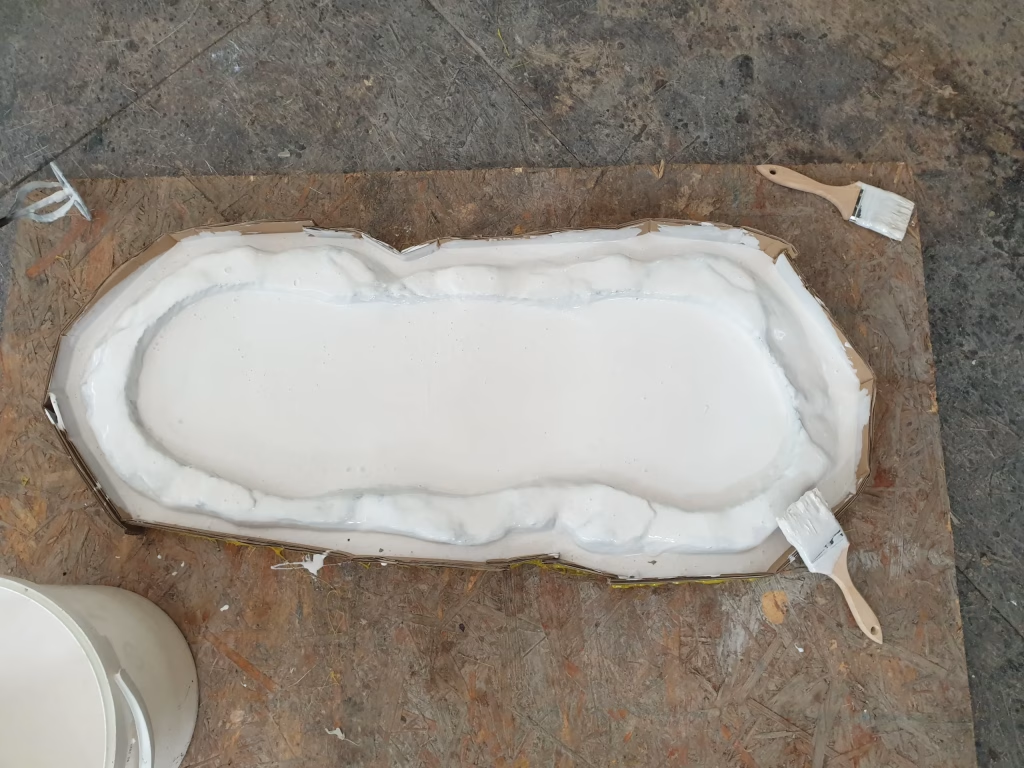
Concrete in a silicone mould: what to watch
- Release agent – often unnecessary with concrete and silicone, but a thin suitable coating eases demoulding and protects the mould surface.
- Compaction – vibration removes air bubbles, but the mould must be properly supported against distortion.
- Demoulding time – remove the casting only once the concrete is strong enough; early removal damages both casting and mould.
- Temperature – do not expose the mould to strong sun or accelerate setting with high heat.
How should a mould be cleaned and stored?
After demoulding, wash with water and mild detergent if needed, then dry. Do not use solvents or stiff brushes. Store in its support shell or flat without bending, in a dry place away from sunlight and heat. Store multipart moulds assembled to avoid separate distortion.
When should a mould be repaired or replaced?
Signs include tears at the edges, lost detail, castings sticking and changes in shape. A small tear can usually be bonded with silicone, but leaves a mark on later casts. Once a mould stops reproducing texture, it is better to make a new one from the retained model, which is why keeping the master is worthwhile.
Silicone or rigid mould?
| Characteristic | Silicone mould | Rigid mould (GRP) |
|---|---|---|
| Detail and undercuts | very good reproduction of texture and undercuts | smooth surfaces, simple divisions |
| Typical castings | concrete, plaster, resins, textures for GRP | series-produced laminate elements |
| Durability | dependent on the casting material | long runs with proper care |
| Manufacturing cost | dependent on silicone quantity and support shell | higher for complex shapes |
How do you order a mould suited to the production run?
A photograph or drawing, dimensions, casting material and planned quantity are enough for pricing. We select silicone, mould divisions and a support shell, and make a master model if needed. Details are on the page bespoke silicone moulds for concrete. Our decorations are also made using moulds, such as the columns in Jungle Quest at Suntago.