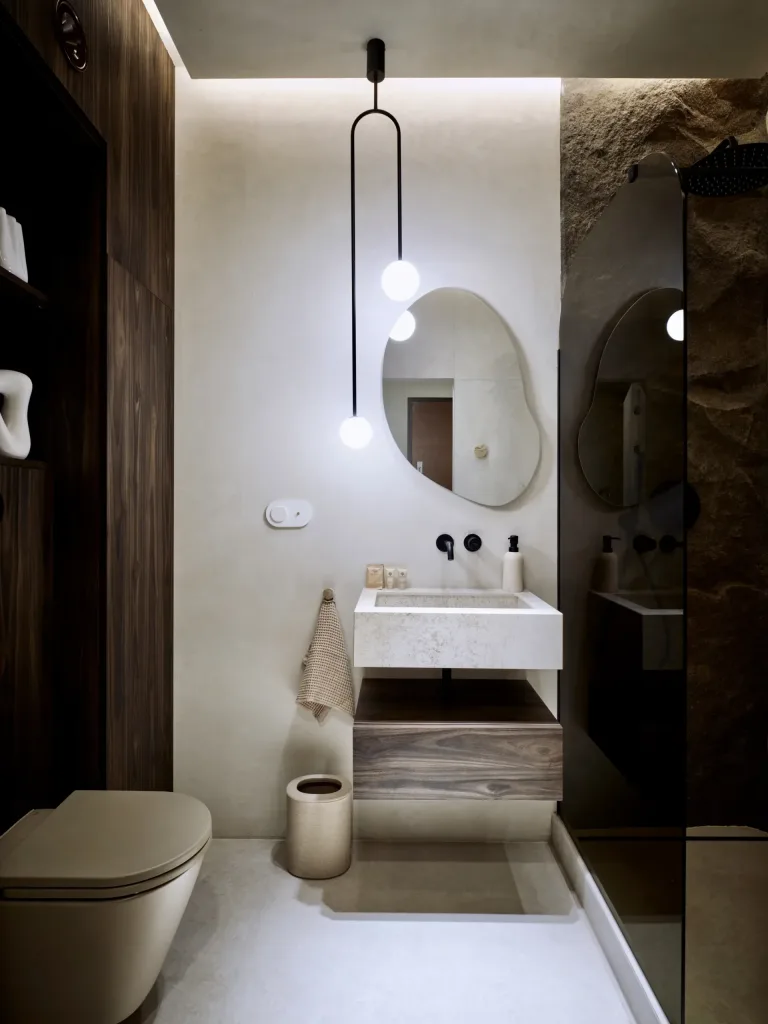
A rock wall is an impressive interior feature. Instead of flat tile cladding, it creates a three-dimensional form resembling natural rock, with folds, cracks and varied colour. It works in living rooms, bathrooms, beside hot tubs, in home SPA areas, hotel lobbies and by pools.
What is an artificial rock wall made of?
At StoneDeco, we make most walls from GRP (glass-reinforced plastic). We cast elements in silicone moulds reproducing real stone, then reinforce them with resin-saturated glass fibre. We refine the texture by hand and apply colour in layers to emphasise recesses and edges.
Such a wall weighs around 6 kg/m². This matters in homes and existing buildings: lightweight cladding avoids heavy floor loads and usually needs no wall reinforcement. Heavy natural-stone or concrete cladding needs a strong substrate and often additional structure.
How much space does a rock wall take?
It depends on the effect you want. Shallower relief gives subtle texture and saves space; deeper forms create distinct ledges, shelves and recesses. We agree depth at the start alongside room dimensions, routes and furniture. Rock can also hide uneven masonry, pipes or an access box.
Is a rock wall a good idea in a bathroom?
Yes, provided the material suits the conditions. GRP is waterproof, does not absorb moisture and can be washed. In bathrooms, we consider:
- areas in direct contact with water – beside a shower or bath, the finish must tolerate frequent cleaning;
- edges and shelves – so that water does not collect and surfaces are easy to wipe;
- ventilation – as in any bathroom, good ventilation protects the entire room from moisture.
An example is a rock shower in a private garden, made as a several-metre rock form with a shower recess.
Sockets, lighting and service access
Rock works well with light. Spotlights or LED strips hidden in cracks bring out texture and create an evening atmosphere. Before making it, we agree sockets, switches, lights and any service access; a section of rock can be removable.
How is it installed at home?
We prepare elements in the workshop, avoiding carving dust and lengthy refurbishment in the home. On site, we fix segments to the wall, join them, conceal interfaces and refine colour under the final lighting. A smaller wall usually takes one to several days to fit.
What determines the price of a rock wall?
There is no single price per metre because every wall differs. The main factors are:
- surface area and wall shape (corners, curves and passages);
- sculpture depth and detail quantity: shelves, recesses and cracks;
- colour and finish – from uniform stone to complex colour variations;
- accessories – lighting, water, plants and rock planters;
- installation conditions – location, access and working height.
Site photographs, approximate dimensions and a few sentences about the desired effect are enough for a quotation. Include any inspiration, such as a rock or interior photograph.
Rock wall versus ready-made 3D panels
Ready-made stone-effect panels are available. They suit a flat wall and smaller budget, but repeat the same pattern and often show joints. A bespoke wall has one continuous design tailored to the room and can create three-dimensional forms that flat panels cannot achieve.