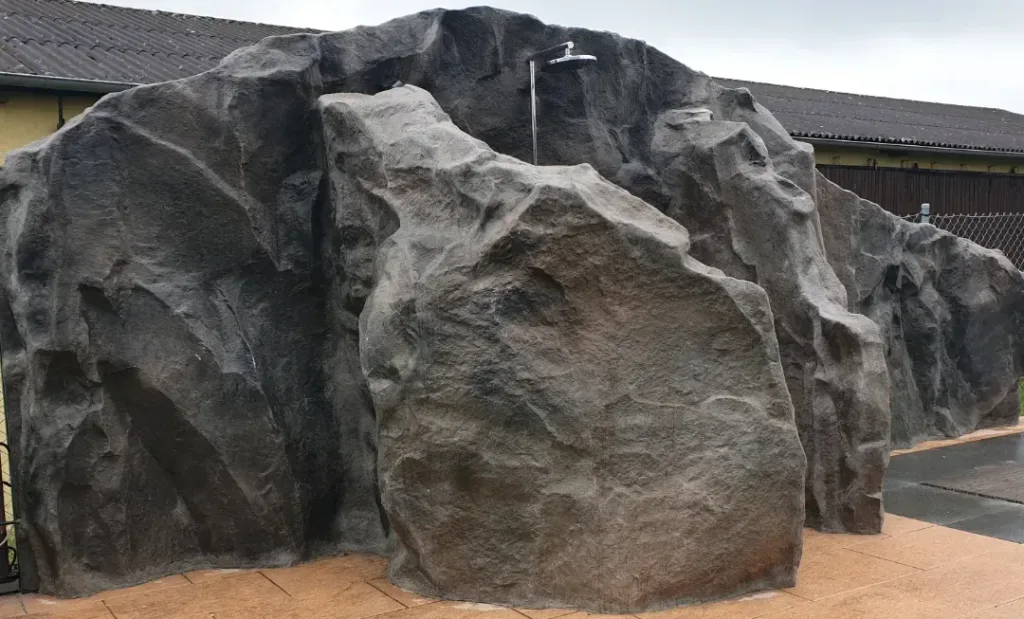
Glass-reinforced plastic – also called glass-reinforced polyester, fibreglass-reinforced polyester or GRP (from the English glass-reinforced plastic) – is one of the most widely used composite materials. It is used to make boat hulls, tanks, equipment enclosures and slides, as well as artificial rocks, grottos and scenery. We work with it every day at the StoneDeco workshop, so we have brought together the key information – from material structure to durability and repairs.
What is GRP (glass-reinforced plastic)?
It is a composite: a material made from two components with different roles. Glass fibre carries loads and provides strength, while polyester resin bonds the fibres into a single rigid whole and protects them from water. Neither component alone has the properties of their combination: resin on its own is brittle, while fibre alone is flexible.
What is it made of?
- Unsaturated polyester resin – liquid when applied, it hardens after a hardener is added. The type is selected to suit the element’s operating conditions, such as constant contact with water.
- Glass fibre reinforcement – usually a mat of chopped fibres arranged in different directions, with fabric or roving also used in more heavily loaded areas.
- Gelcoat – an outer, smooth layer of pigmented resin, applied to the mould first. It provides the colour and surface appearance and protects the GRP from moisture and UV radiation.
- Fillers and additives – for example, quartz sand or pigments that change the product’s texture, colour or properties.
How is a GRP element made?
The most common method, also for decorations and short runs, is hand lay-up in a mould:
- The mould is treated with a release agent.
- Gelcoat is applied; after removal from the mould, it will form the product’s outer surface.
- Successive layers of glass mat are laid and impregnated with resin, with a roller used to remove trapped air. The number of layers depends on the strength required.
- Once cured, the element is removed from the mould, the edges are trimmed and, where needed, it is reinforced and connected to a structure.
Industry also uses spray-up, vacuum infusion and compression moulding to produce consistent products in large runs. For artificial rocks and scenery, however, hand finishing matters: we model and paint the texture to look like stone close up.
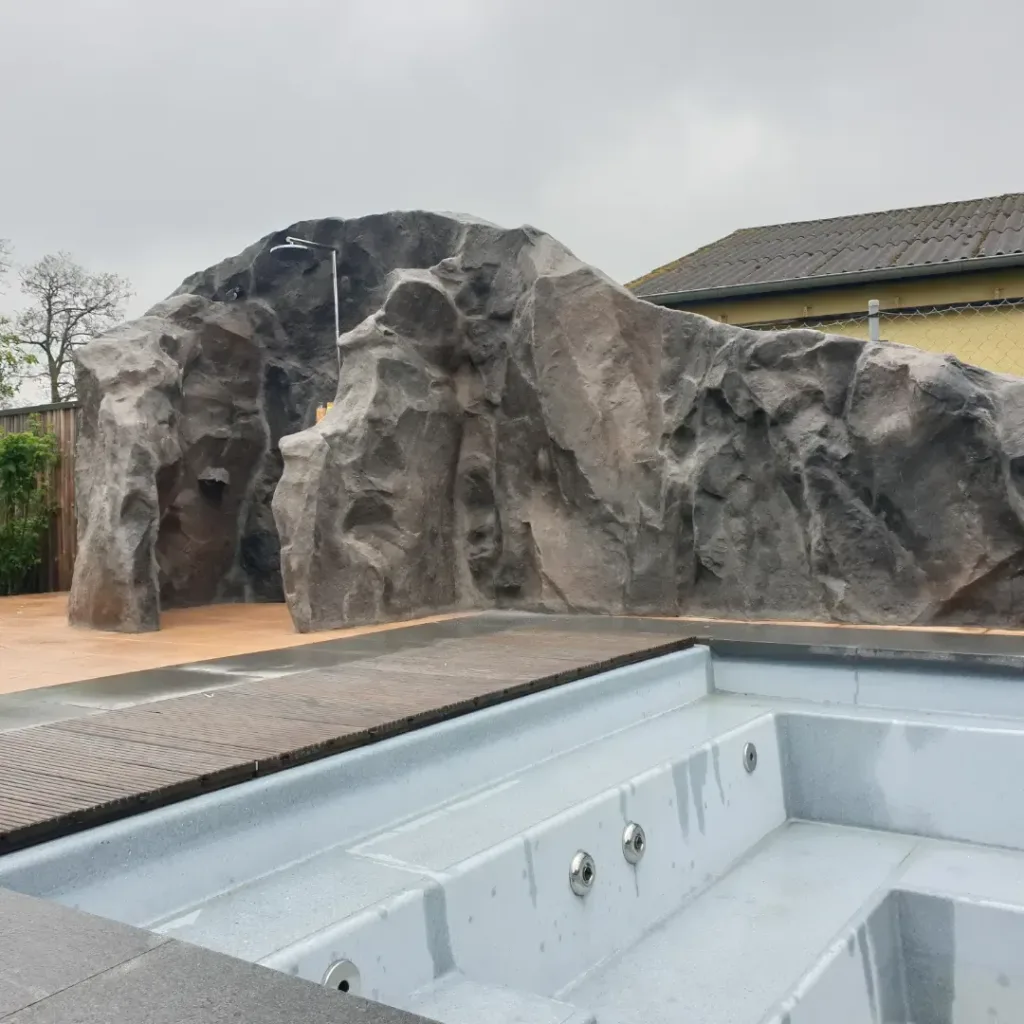
Properties of GRP (glass-reinforced plastic)
- Low weight with high strength – a GRP element is many times lighter than a similar concrete or stone one. Our rock decorations weigh approx. 6 kg/m² of surface area, which makes transport and installation on walls, in a pool hall or on a ship’s deck easier.
- Resistance to water, moisture and corrosion – GRP does not rust or rot and has very low water absorption, making it suitable for swimming pools, water parks, bathrooms and gardens.
- Freedom of shape – a mould can reproduce every detail, from rock texture to relief on a column, and many identical elements can be made from one mould.
- Weather resistance – with the right finish, GRP withstands rain, frost and sun well.
- Repairability – a crack or missing section can be repaired locally without replacing the entire element.
- Insulating properties – GRP does not conduct electricity and is a poor conductor of heat, which matters for equipment enclosures.
Limitations worth knowing
- UV radiation – unprotected resin becomes dull and yellow over time. Outdoor elements are therefore coated with gelcoat or UV-resistant paint, and the coating is refreshed periodically.
- Point impacts – GRP is resilient, but a strong impact at one point can crack the gelcoat or cause delamination. Thicker GRP or additional reinforcement is used in areas exposed to contact.
- Flammability – standard polyester GRP is flammable. Where a facility has fire safety requirements, resins with reduced flammability are used – it is worth agreeing the requirements before production.
- Production conditions – resins contain styrene, so laminating takes place in a ventilated workshop and finished elements are installed at the facility.
Polyester or epoxy composite?
| Characteristic | Polyester composite | Epoxy composite |
|---|---|---|
| Material cost | lower | higher |
| Strength and adhesion | sufficient for most applications | higher |
| Curing shrinkage | greater | smaller |
| Typical applications | tanks, boats, enclosures, decorations, architectural elements | sports and aerospace elements, precision parts, structural repairs |
For decorations, scenery and functional elements, polyester GRP offers the best balance of capabilities and cost. Epoxy resin is chosen where maximum strength or adhesion to other materials matters.
Where is GRP used?
- Marine industry and transport – boat hulls, covers, vehicle bodywork and interior components.
- Construction and services – tanks, ducts, gratings, coverings and façade elements.
- Swimming pools and recreation – pool shells, slides and water attractions.
- Decorations and scenery – artificial rocks, grottoes and caves, artificial trees, props and bespoke forms.
- Bespoke enclosures and elements – equipment covers, display stands, planters and inspection chamber covers.
Why do we make decorations from GRP?
We have made artificial rocks, grottos and trees from GRP for over 20 years. It allows us to build a large, realistic form with low weight and install it where stone or concrete would be too heavy – on a bathroom wall, beside a hotel pool or on a cruise ship’s deck. The elements are made in the Wołów workshop, and we install finished sections at the facility, reducing on-site work to a few days or nights.
We finish the texture and colour of each decoration by hand and agree the division into elements and installation method for each specific location. We explain when sprayed concrete may be preferable and when GRP works better in the comparison Artificial rocks made from GRP or concrete?

Durability, care and repair
Well-made, properly finished GRP lasts for many years. For everyday care, washing with water and a mild detergent is enough – avoid abrasives that dull the surface. Elements exposed to strong sunlight should be inspected every few years and their coating renewed if necessary.
Cracks, gelcoat chips and missing sections caused by impacts are repaired locally: the damaged area is cleaned and sanded, new GRP layers are added and the finish is recreated. We provide this as part of our service GRP product repairs.
How much does a GRP element cost?
Price depends primarily on whether the element is a one-off piece or part of a production run. For a run, the largest one-off cost is the mould, spread across successive castings. For one-off decorations, size, level of detail and hand finishing matter. We prepare quotations for elements and production runs as part of bespoke GRP production – a drawing, photograph or dimensions are enough to get started.